Tell the Machine a Better Story — Then Read the One It Tells Back
A good story and a good AI prompt are the same four moves, until they split on one axis. Prompting is storytelling for machines, and a fluent answer still needs checking.

In the last note I argued that storytelling is how you transmit an idea to an AI: imagine the thing clearly, tell its story, and the build lands closer. I believed it from experience. What surprised me is how exactly it holds up against two bodies of evidence that have no reason to agree — the craft canon on how to tell a story well, and the current, official guidance on how to prompt a model well.
They line up almost exactly. And then, on one axis, they invert — and that inversion is the more important half of the essay.
Two Crafts, One Job
Strip away the surface and a storyteller and a prompt-writer are doing the identical thing: building an accurate model inside another mind using nothing but words. The novelist wants a specific picture to form in a stranger's head. You want a specific system to form in the model's "head." Neither of you can point at the thing. You can only describe it well enough that the other party reconstructs it correctly.
Both crafts are theory of mind. You win by transmitting a model, not by issuing a command.Once you see the job that way, the "tricks" of each craft stop looking like tricks. They're the same four moves, wearing different clothes.
The Same Four Moves
I put the storytelling principles next to Anthropic's own current prompting guidance, expecting a loose rhyme. It's closer to a translation.
Cause, not sequence. E.M. Forster's line from 1927: "the king died and then the queen died" is a sequence; "the king died, and then the queen died of grief" is a story — the because is the whole difference. Anthropic's prompting guide says the same thing in an engineer's accent: don't just give the instruction, "provide context or motivation behind" it, and the model "generalizes from the explanation." A rule without its reason is a bead with no string.
Specific is trust. Le Guin and Zinsser spent careers on one idea — the concrete detail is what makes a reader build the right picture instead of a plausible-generic one. The docs: be explicit, and "tell Claude what to do instead of what not to do." Vagueness is where both a reader and a model quietly fill in the wrong thing.
Cut to the load-bearing. Aristotle wanted every part of a plot to be necessary — remove one and the whole is disturbed. Strunk said omit needless words. The 2025 phrase for it is "context engineering": find "the smallest possible set of high-signal tokens." The CLAUDE.md test is literally "would removing this line cause a mistake?" Same scalpel.
Writing surfaces the gaps. Amazon makes teams write the six-page narrative before they build, because you cannot write a coherent paragraph over a hole in your thinking. Claude Code's first rule is explore, then plan, then code — write the plan before the diff, and the plan shows you what you didn't know. In both, the writing is the thinking, not the record of it. The plan I write before a single line of code changes is usually four plain sentences:
1Before you touch the code:2 1. List the files in play and what each one does.3 2. Name the single behaviour that has to change.4 3. Say what could break — and the check you'll run to catch it.5Then, and only then, write the diff.Four for four. If the essay stopped here, the title would just be "prompting is storytelling," and that would be a tidy, true, forgettable point. It doesn't stop here.
Then They Split
Here is where the two crafts stop being the same craft.
A story succeeds by transportation — the reader is absorbed, carried, and stops arguing with the page. This isn't a metaphor; it's a measured effect. In the foundational study (Green and Brock, 2000), the more transported a reader was, the fewer "false notes" they caught — absorption quietly lowers your guard. That is the engine of good storytelling. It is also, precisely, its danger.
Now look at what the same official guidance says about the machine's output. "Show evidence, not assert success." "Never speculate about code you have not opened." Add an adversarial reviewer. Give it a test it can actually run. Every one of those rules is built to do the opposite of transportation: to stop you from being carried along by a fluent, confident answer.
So the same skill points two directions at once. When you write the prompt, you are the storyteller — you want your framing to carry. When you read the reply, you are the audience the story is being told to — and now transportation is the enemy. The machine is a better storyteller than most people give it credit for. Its answers are coherent, well-shaped, and delivered without a flicker of doubt. That fluency is exactly what you must not fall for.

A Coherent Answer Can Still Be Wrong
This is the line I hedged in the last note, and the research turned the hedge into the main point. I wrote then that "a coherent story doesn't prove you're right — consistency isn't truth." I meant it as a caveat. It's actually the hinge of the whole thing.
A story can be flawless and false — that's the entire premise of fiction. An AI's answer can be flawless and false in exactly the same way: every step follows from the last, the shape is right, and the whole thing is confidently pointed at the wrong target. The better the storyteller — human or model — the harder this is to catch, because coherence is the thing that switches off your scrutiny. The scariest bug isn't the answer that looks wrong. It's the one that reads beautifully and is wrong.
Coherence is a filter you run on your own thinking as the writer — and a trap the reader falls into. Use it in the first role, distrust it in the second. When the model hands you something clean, that's not a reason to relax. It's the exact moment to open the file.
Critical Thinking Is the Hinge
Which is why the skill underneath both crafts isn't storytelling and it isn't prompting. It's critical thinking — the thing that lets you hold both stances at once. You craft the most coherent, transporting story you can for the reader and for the model, and in the same breath you refuse to be transported by anything that comes back.
You are the world's most sympathetic author and its most sceptical reader, in the same hour, about the same work.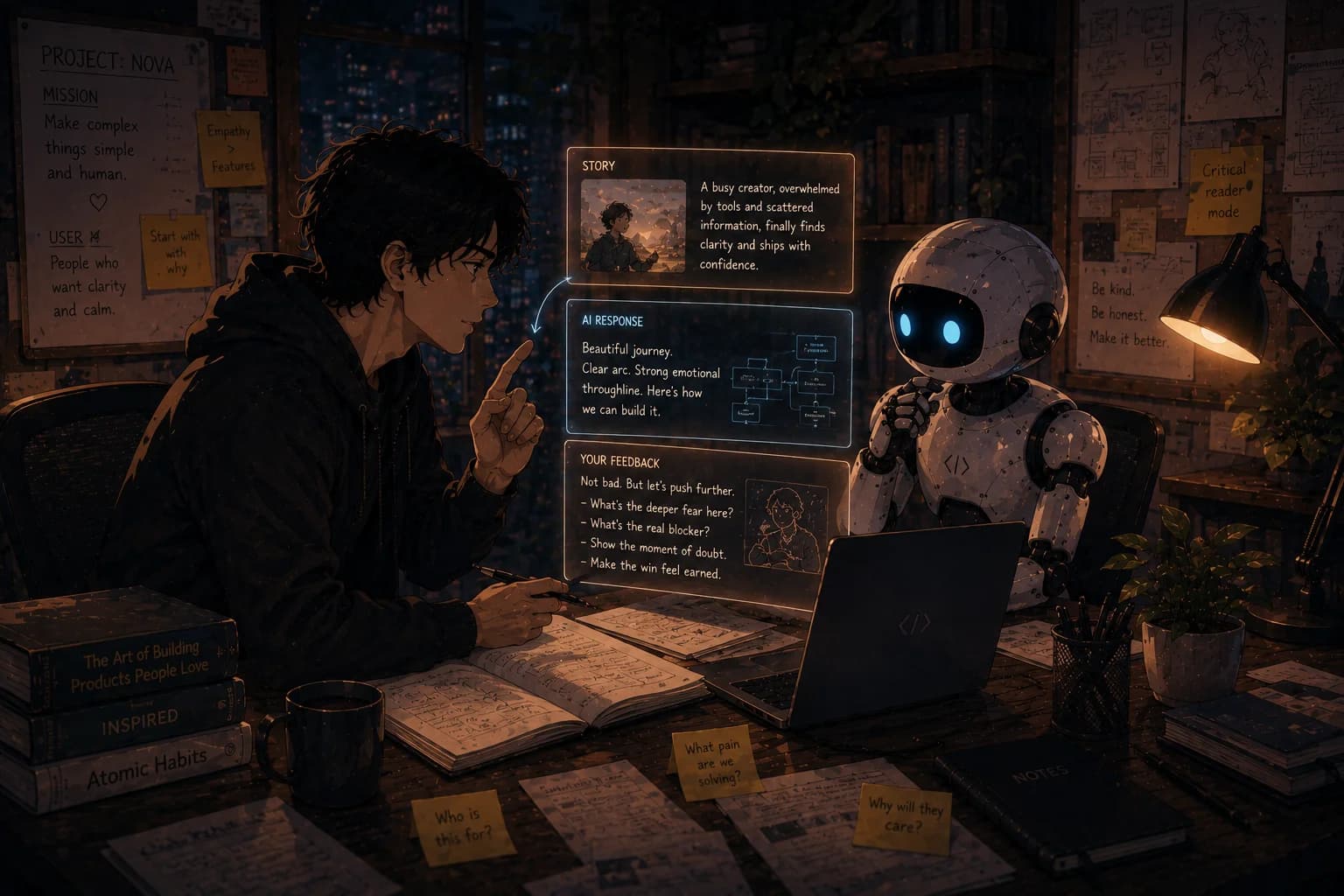
That loop — write it warm, then read it cold — is the whole discipline in one picture. Reduced to its mechanics, it's just a balance:
This is the same principle I keep circling from different sides. Explore before you instruct. Read the PR even when the code looks right. Tell the machine a better story — and then read the one it tells back, with your guard up, because it's a good storyteller too.
The four moves that make a story land are the four moves that make a prompt work: cause, specificity, economy, and writing to find your own gaps. But a story wins by lowering the guard, and building with a machine only works if you keep yours up. Be the best storyteller in the room when you write. Be the most sceptical reader in the room when you read what came back. The whole craft is knowing which one you are right now.